Bizarre 'Faceless Cusk Eel' Filmed Alive in the Ocean Abyss Off Cook Islands | Khmer Digital News
Deep-sea researchers capture rare footage of the elusive 'faceless cusk eel' (Typhlonus nasus) swimming thousands of meters below the surface off the Cook Islands
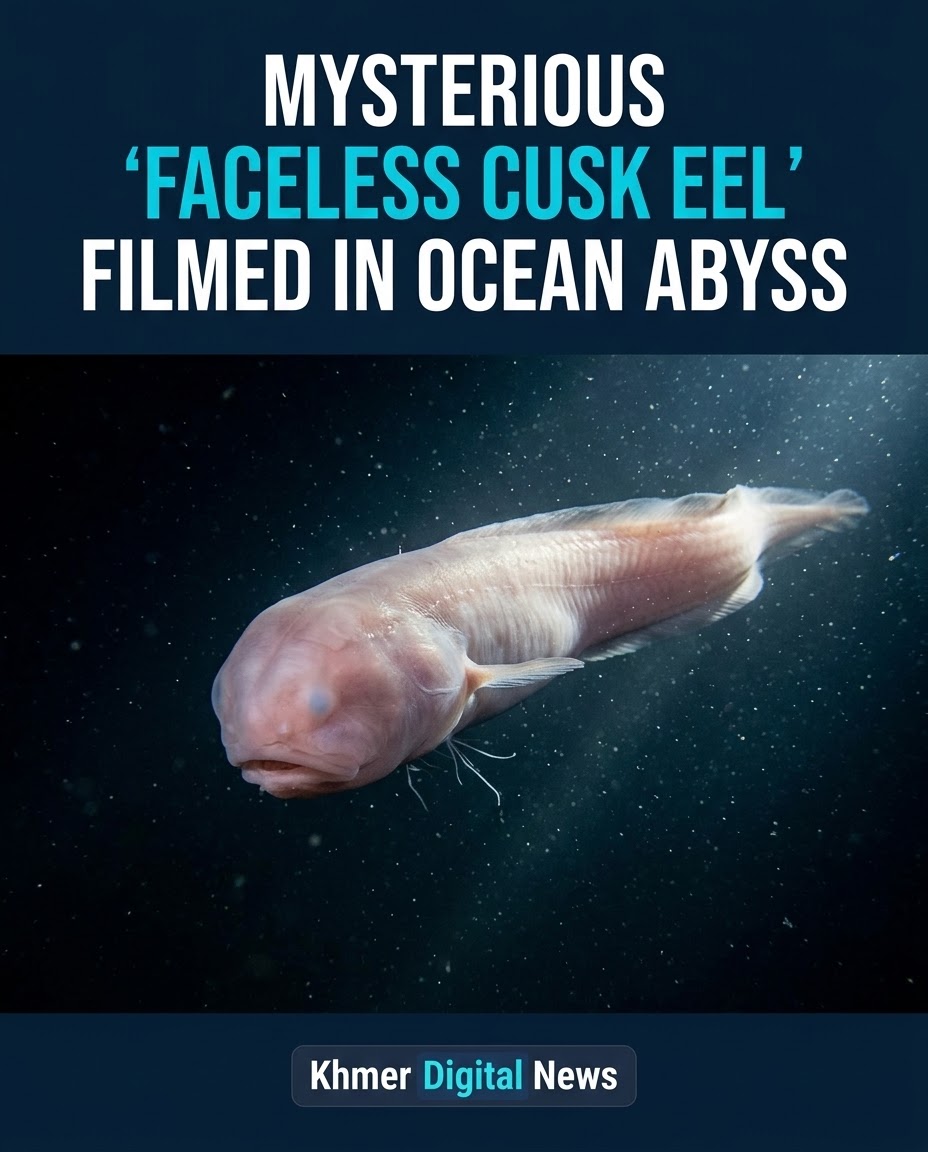
Bizarre 'Faceless Cusk Eel' Captured on Camera in the Deep Ocean Abyss Off the Cook Islands
By Khmer Digital News Editorial Team | Published: October 15, 2026
Key Takeaways:
Marine researchers operating deep-sea submersibles off the Cook Islands filmed rare, live footage of the elusive faceless cusk eel (Typhlonus nasus).
Inhabiting abyssal depths between 4,000 and 5,000 meters, the species appears to lack external eyes or a conventional face.
The sighting offers valuable biological insight into how deep-ocean organisms adapt to pitch-black darkness and crushing hydrostatic pressure.
COOK ISLANDS — An oceanographic expedition deploying remotely operated vehicles (ROVs) across the deep-sea floor of the Cook Islands in the South Pacific has captured extraordinary high-definition video of one of the planet's most enigmatic marine vertebrates: the faceless cusk eel (Typhlonus nasus), as shared by the Cook Islands Ocean Exploration team.
Why Does the Deep-Sea Creature Appear 'Faceless'?
Illuminated by the submersible's spotlight thousands of meters beneath the ocean surface, the pale, translucent fish glides effortlessly above the sediment with a smooth, bulbous head that appears completely devoid of eyes, nostrils, or a forward-facing mouth. Marine biologists explain that in the abyssal zone—ranging from 4,000 to over 5,000 meters deep—sunlight never penetrates, rendering conventional vision obsolete. While juvenile specimens possess tiny microscopic eye structures, in adults they remain buried deep beneath layers of translucent skin. Instead of a forward mouth, the faceless cusk eel features a protrusible jaw tucked underneath its head, allowing it to vacuum up small crustaceans and organic detritus from the seafloor mud (Cook Islands ROV Abyss Exploration).
A Century-Long Scientific Mystery Since HMS Challenger
Despite its striking anatomy, Typhlonus nasus is not a true eel, but a member of the cusk-eel family (Ophidiidae). The species was first scientifically described in the 1870s after a single specimen was dredged from the Coral Sea during the historic global voyage of the British research vessel HMS Challenger. Because abyssal habitats are extraordinarily difficult to survey, more than a century passed before researchers encountered the species again during a 2017 Australian deep-sea survey. Observing a living specimen swimming naturally in its undisturbed Pacific habitat represents a rare triumph for modern ROV exploration.
Evolutionary Adaptation to Extreme Hydrostatic Pressure
At depths exceeding four kilometers, marine life must endure hydrostatic pressures more than 400 times greater than at sea level alongside near-freezing temperatures. Rather than relying on sight, the faceless cusk eel navigates its pitch-black ecosystem through enlarged sensory pores and specialized lateral-line organs that detect subtle water vibrations and chemical cues. Researchers noted that documenting abyssal biodiversity around the Cook Islands helps establish baseline ecological records needed to protect fragile deep-ocean ecosystems.
Primary Sources: Reported by the Khmer Digital News Editorial Team based on deep-sea expedition documentation from Cook Islands Ocean Exploration.