
The Singapore Economic Miracle: Meritocracy, EDB Industrial Policy, and World-Class Human Capital
Deep-dive case study into Singapore's economic development miracle, meritocratic governance, Economic Development Board (EDB) strategies, and world-leading educational investments.
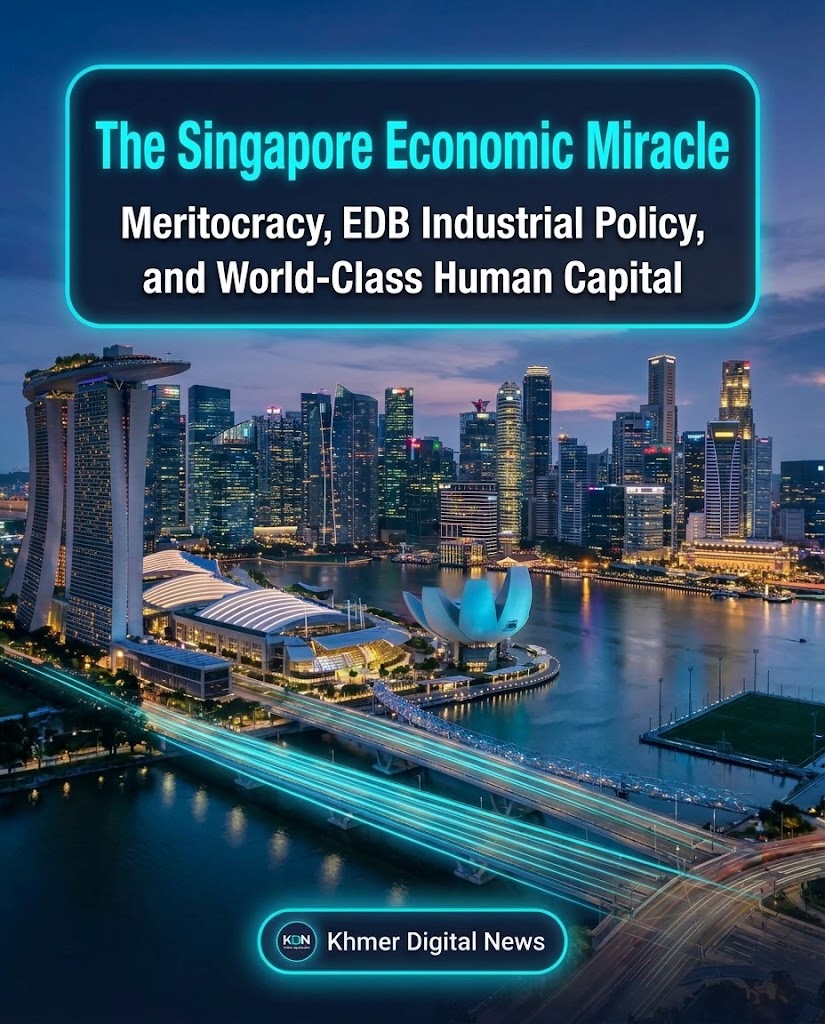
The Singapore Economic Miracle: Meritocracy, EDB Industrial Policy, and World-Class Human Capital
- Meritocratic governance ensures public institutions are steered strictly by talent, integrity, and measurable performance.
- The Economic Development Board (EDB) coordinates proactive industrial policy, pairing FDI attraction with domestic workforce upskilling.
- Unrelenting human capital investment and SkillsFuture lifelong learning programs underpin long-term economic agility.
Lacking natural resources at independence in 1965, Singapore engineered an unprecedented economic transformation through strategic pragmatism.
1. Meritocratic Governance and Zero Tolerance for Corruption
Rigorous merit-based public service recruitment paired with competitive compensation structures ensures high bureaucratic efficacy and business trust.
2. Coordinated Industrial Evolution via EDB
The EDB continually identifies high-growth global industries—from microelectronics to biomedical sciences—anchoring multinational partners through comprehensive ecosystem support.
3. World-Leading Educational Frameworks and Lifelong Learning
Beyond consistently ranking at the apex of global PISA assessments, Singapore champions continuous adult workforce retraining via SkillsFuture credit allocations.
Q: What defines Singaporean meritocracy?
A: A system where appointments, education, and career advancement are allocated strictly by aptitude and proven output.
Q: How does SkillsFuture support workers?
A: By providing government credits directly to citizens to fund certified professional upskilling throughout their careers.