
Nvidia CEO Jensen Huang Reassures Global Markets: AI Turmoil 'Will Pass' as Fundamentals Hold Strong
Nvidia CEO Jensen Huang delivered a reassuring message to global markets, stating that recent semiconductor stock volatility will pass as core AI infrastructure demand remains robust.
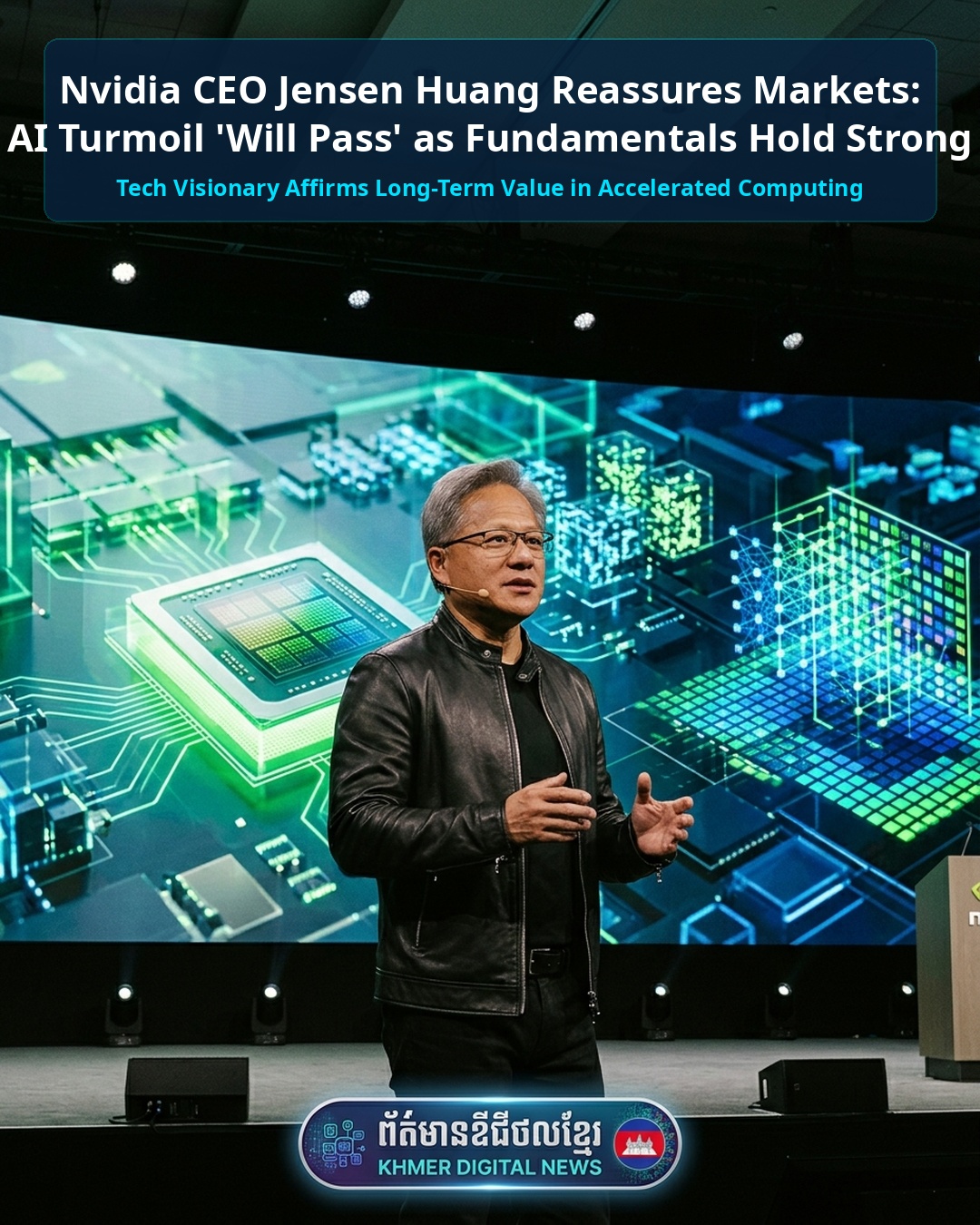
By Khmer Digital News Editorial Team | Published: October 17, 2026
Key Takeaways:
- Calming Market Anxiety: Nvidia President and CEO Jensen Huang dismissed recent tech stock sell-offs as transient noise, affirming that artificial intelligence fundamentals remain extraordinarily healthy.
- Structural Computing Transition: Global enterprises are undergoing a multi-trillion-dollar migration from legacy general-purpose CPUs to accelerated GPU computing platforms.
- Expanding Real-World Deployment: Nvidia deepened its autonomous driving collaboration with Mercedes-Benz and committed $250 million to advance sovereign AI safety research in Europe.
Amid widespread volatility across global semiconductor equities, the executive widely recognized as the architect of the modern AI computing era has delivered a decisive message of composure. Speaking to industry leaders and financial analysts, Nvidia CEO Jensen Huang directly addressed investor concerns regarding capital expenditures on artificial intelligence.
Projecting unwavering confidence, Huang stated that "all of this is going to pass," emphasizing that the profound macroeconomic shift toward accelerated computing and agentic AI models is only in its foundational stages.
1. Context Behind the Recent Technology Sell-Off
In recent trading cycles, technology indices faced downward pressure as market participants questioned the timeline for return on investment regarding massive data center buildouts. The Philadelphia Semiconductor Index experienced consecutive declines, and credit spread widening at key AI cloud partners raised temporary speculation about an impending sector plateau.
These market fluctuations prompted debates over whether infrastructure spending had outpaced commercial software revenue. Skeptics questioned how quickly enterprises could monetize generative AI applications at enterprise scale.
2. Jensen Huang's Structural Argument: The Shift to Accelerated Computing
Addressing these concerns, Huang articulated that the demand for high-performance computing represents a mandatory structural modernization rather than a cyclical hype cycle. With Moore's Law plateauing for general-purpose CPUs, accelerated computing powered by specialized GPUs provides the only cost-effective pathway to process the exponential growth of digital data.
Huang underscored that every commercial enterprise will eventually operate custom AI agents across internal workflows, customer support, software development, and industrial robotics. Consequently, computing infrastructure is transitioning from static repositories of data into active "AI factories" generating intellectual output on demand.
3. Strategic Expansions in Automotive and Scientific Research
Demonstrating tangible commercial traction, Nvidia announced an expanded multi-year partnership with luxury automaker Mercedes-Benz to deploy next-generation automated driving architectures and software-defined vehicle platforms.
Concurrently, Nvidia pledged a $250 million investment to support sovereign AI safety initiatives and accelerated computing research in the United Kingdom. By embedding its proprietary CUDA architecture and silicon hardware across transportation, scientific discovery, and national laboratories, Nvidia continues to anchor its position as the indispensable backbone of the intelligence economy.
Frequently Asked Questions (FAQ):
Q: Who is Jensen Huang?
A: Jensen Huang is the co-founder, President, and CEO of Nvidia, the world's preeminent designer of graphics processing units (GPUs) and accelerated computing platforms powering artificial intelligence.
Q: Why are Nvidia GPUs so essential for modern artificial intelligence?
A: Unlike conventional CPUs that execute tasks sequentially, Nvidia GPUs process thousands of computations concurrently (parallel processing), making them uniquely suited to train and run massive neural network architectures efficiently.
Official Sources: Financial reporting from The Edge / Reuters (October 17, 2026) and corporate communications from the NVIDIA Newsroom.
