
The 10-Minute Brain Reset: How Non-Sleep Deep Rest (NSDR) Restores Peak Mental Energy
Discover the neuroscience of Non-Sleep Deep Rest (NSDR), how a 10-minute guided relaxation protocol replenishes dopamine by 65%, and how to practice it daily.
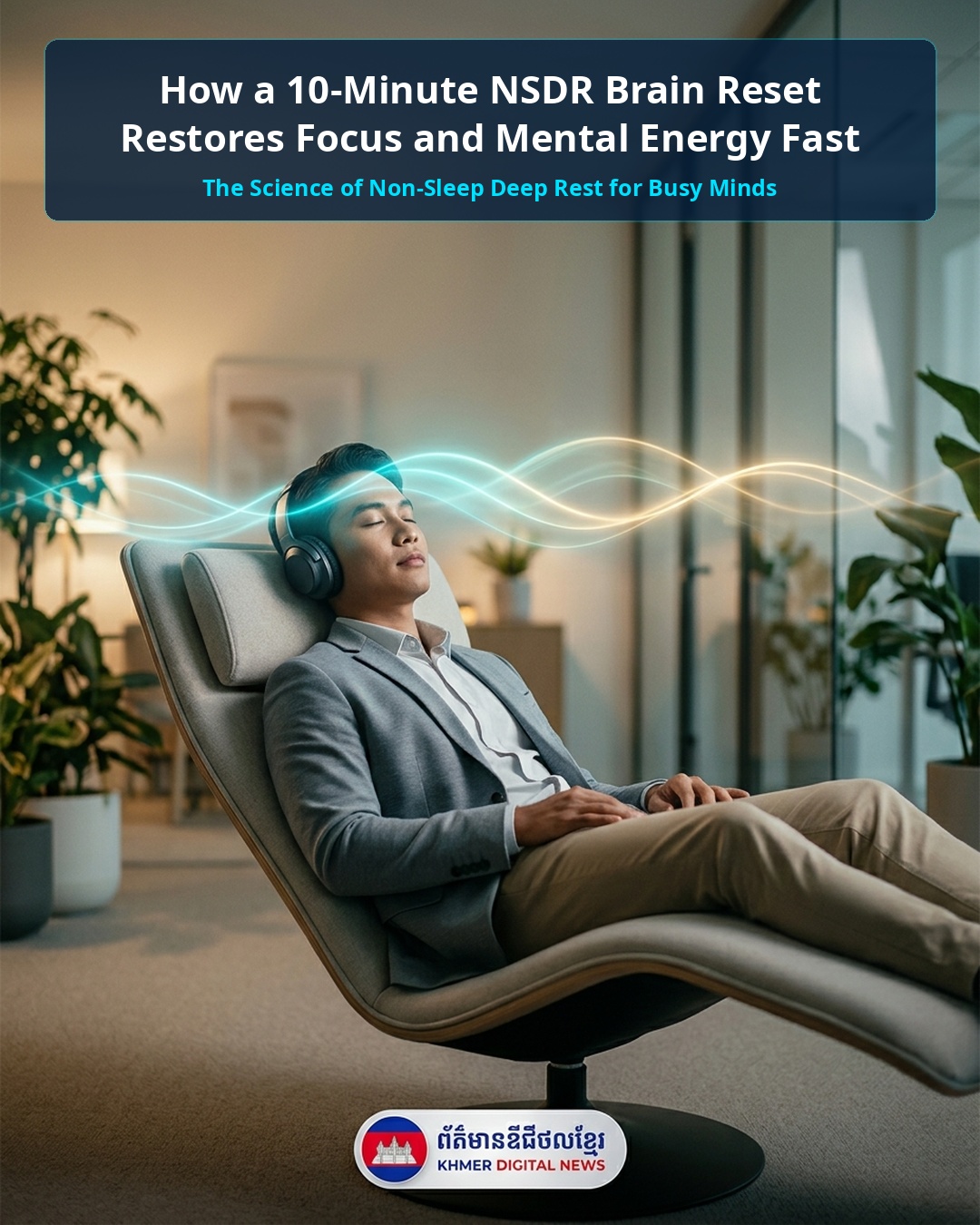
By Khmer Digital News Editorial Team | Published: October 16, 2026
Key Takeaways:
- Non-Sleep Deep Rest (NSDR) is an evidence-based, self-directed relaxation protocol popularized by Stanford neurobiologist Dr. Andrew Huberman.
- By guiding the brain from active beta waves into restorative alpha and theta frequencies, a 10-to-20-minute NSDR session can increase striatal dopamine reserves by up to 65%.
- Unlike traditional afternoon naps that often trigger groggy sleep inertia, NSDR delivers deep autonomic recovery while leaving you immediately alert.
PHNOM PENH — When the mid-afternoon energy slump hits, taking a traditional nap often backfires, leaving you disoriented and sluggish from sleep inertia. Fortunately, neuroscientists have validated a zero-cost, 10-to-20-minute physiological protocol known as Non-Sleep Deep Rest (NSDR) that restores mental clarity, replenishes neurochemical reserves, and accelerates memory consolidation without requiring actual sleep, according to clinical reviews by the Sleep Foundation and Huberman Lab.
1. What Is NSDR and How Does It Shift Brain States?
Coined by Stanford University School of Medicine neuroscientist Dr. Andrew Huberman, NSDR serves as an umbrella term for secular, science-grounded relaxation protocols—including traditional Yoga Nidra and clinical progressive body scanning—that guide the nervous system into a state of profound physical stillness while maintaining gentle conscious awareness.
By pairing long, slow exhalations with systematic interoceptive body scanning, NSDR activates the parasympathetic nervous system, decelerating heart rate and shifting cortical activity from high-frequency beta waves down into regenerative alpha and theta wave states (Sleep Foundation NSDR Overview).
2. Three Proven Neurobiological Benefits of NSDR
Positron emission tomography (PET) imaging and clinical sleep studies highlight three transformative benefits of daily NSDR practice:
- 65% Surge in Baseline Dopamine: Neuroimaging studies of Yoga Nidra/NSDR practitioners revealed up to a 65% increase in endogenous dopamine release within the striatum, restoring motivation and executive readiness for afternoon work.
- Accelerated Neuroplasticity and Learning: Engaging in a 20-minute NSDR session immediately following an intense learning or study block significantly accelerates the hippocampal replay required to cement new neural pathways.
- Cortisol Reduction and Sleep Debt Recovery: While NSDR does not replace nocturnal slow-wave sleep, a 20-minute session effectively offsets cognitive deficits caused by a fragmented night's sleep (Huberman Lab NSDR Science).
3. How to Execute a 10-Minute NSDR Protocol Today
Practicing NSDR requires no specialized equipment. Lie flat on a couch or recline comfortably in a quiet chair, close your eyes, and inhale deeply through your nose followed by an extended, slow exhale through your mouth. Over 10 minutes, systematically direct your attention from your toes up through your legs, torso, shoulders, and jaw, consciously releasing muscular tension at each point.
Frequently Asked Questions (FAQ)
Question: How is NSDR different from standard mindfulness meditation?
Answer: Traditional mindfulness meditation requires active attentional effort to focus on a single anchor, whereas NSDR is a passive, restorative protocol designed to disengage executive effort completely.
Question: When is the optimal time of day to practice NSDR?
Answer: The ideal window is during the natural circadian dip between 1:00 PM and 3:00 PM, or immediately following an intensive study or deep-work block.
Primary Sources: Reported by the Khmer Digital News Editorial Team based on sleep and neurobiology research from the Sleep Foundation and Huberman Lab.