Effective Tips for Negotiating a Salary Increase After Probation
Learn salary negotiation techniques after completing your probation period, tailored to the context, performance, and professional communication with your manager.

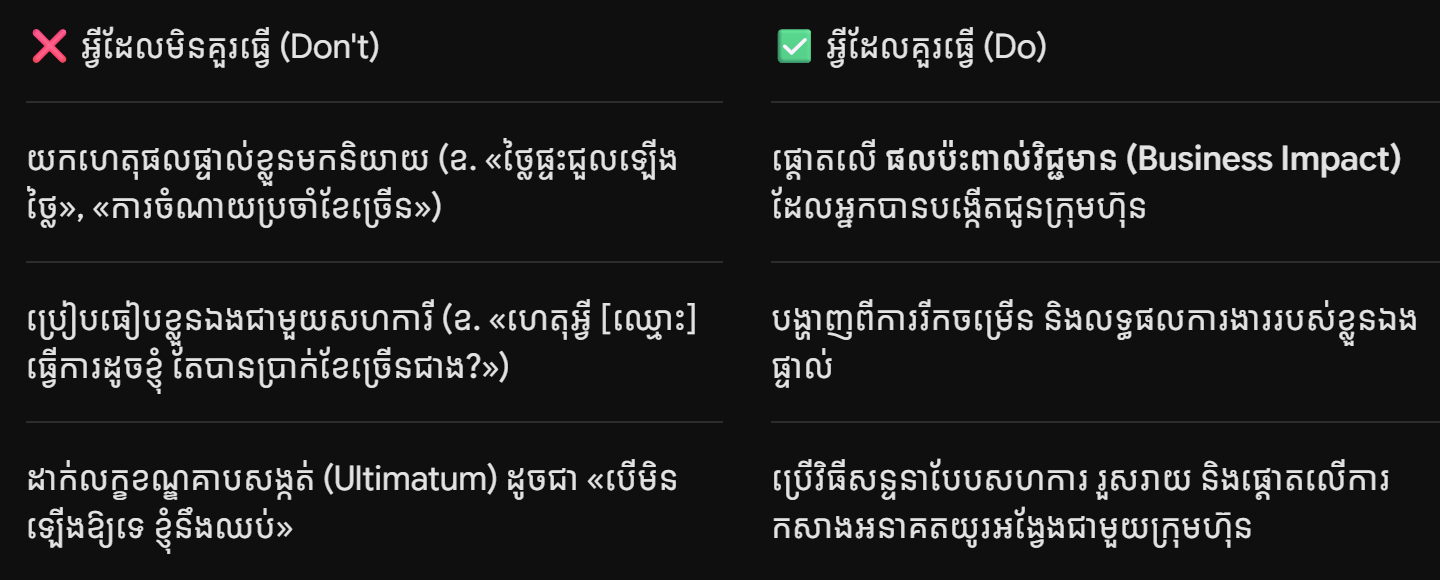
Professional and Confident Tips for Negotiating a Salary Increase After Probation
For many first-jobbers and junior employees, the three-month probation period is a stage full of pressure and learning. However, as the end of probation approaches, a sensitive question often arises: "How should I negotiate my salary so that it doesn't look like too much of a demand, but still reflects fair value for my abilities?"
In reality, salary negotiation after probation is not about asking for a favor; it is a professional conversation based on your performance and the added value you have provided to the company.
Below are practical strategies, clear steps, and actionable scripts that you can apply immediately.
1. Pre-Negotiation Preparation
Successful negotiation starts before you even walk into the meeting room. Do not meet with your manager without concrete data in hand.
A. Track Your Wins
Do not just say, "I work very hard," because everyone works hard. Instead, use real data:
- Volume and Quality: What tasks or projects did you complete before the deadline?
- Problem-solving: What team workflows did you facilitate or what blockers did you eliminate over the past three months?
- Beyond Scope: Did you take on extra responsibilities outside your original job description?
B. Understand Market Standards and Company Policy
- Employment Agreement: Check if your contract specifies any automatic salary increases after probation.
- Market Benchmark: Understand the average salary range for your role in Cambodia's current job market. Generally, post-probation increases range from 10% to 20% depending on performance and company size.
2. Timing is Everything
The wrong timing can cause a well-reasoned negotiation to fail.
- Appropriate timing: About two to three weeks before probation ends, during your probation review meeting or a one-on-one meeting with your manager.
- Avoid: Do not bring up salary when your manager is extremely busy, when the company is facing major issues, or via brief chat messages without prior scheduling.
3. Actionable Scripts
Script 1: Requesting a One-on-One Meeting via Email / Internal Chat
Subject: Probation Review & Performance Discussion - [Your Name]
"Dear [Manager's Name], As my probation period is coming to an end later this month, I would like to request about 30 minutes for a one-on-one meeting to review my performance, receive feedback for improvement, and discuss the next steps and compensation for the full-time role. What days are you available this week?"
Script 2: Verbal Delivery During the Meeting
"Thank you very much, [Manager's Name], for your feedback and guidance so far. Over these past three months, I have truly enjoyed participating in [Project Name] and achieving [specific results]. Based on my current responsibilities and my commitment to continuing to add value to the company, I would like to discuss adjusting my base salary from [$X] to [$Y]. What are your thoughts on this?"
💡 Pro-Tips for First-Jobbers
If the company has budget constraints and cannot immediately increase your salary to your desired amount, do not give up yet! You can negotiate alternative options such as:
- Review in 3 to 6 months (Clear KPI Review): Set specific goals with a guaranteed increase upon completion.
- Non-monetary benefits: Additional annual leave, learning/training allowance, or hybrid/remote work days.
Conclusion
Salary negotiation is not a win-lose competition, but an opportunity to demonstrate career maturity, self-awareness, and readiness to contribute to organizational growth. As long as you have clear data, a positive attitude, and professional communication, you can approach this conversation with high confidence.