Why Do We Get Static Shocks When Touching Skin in Bed? Science & Prevention | Khmer Digital News
Discover the scientific physics behind waking up with static electricity shocks in air-conditioned rooms, the triboelectric effect, and practical ways to prevent it.
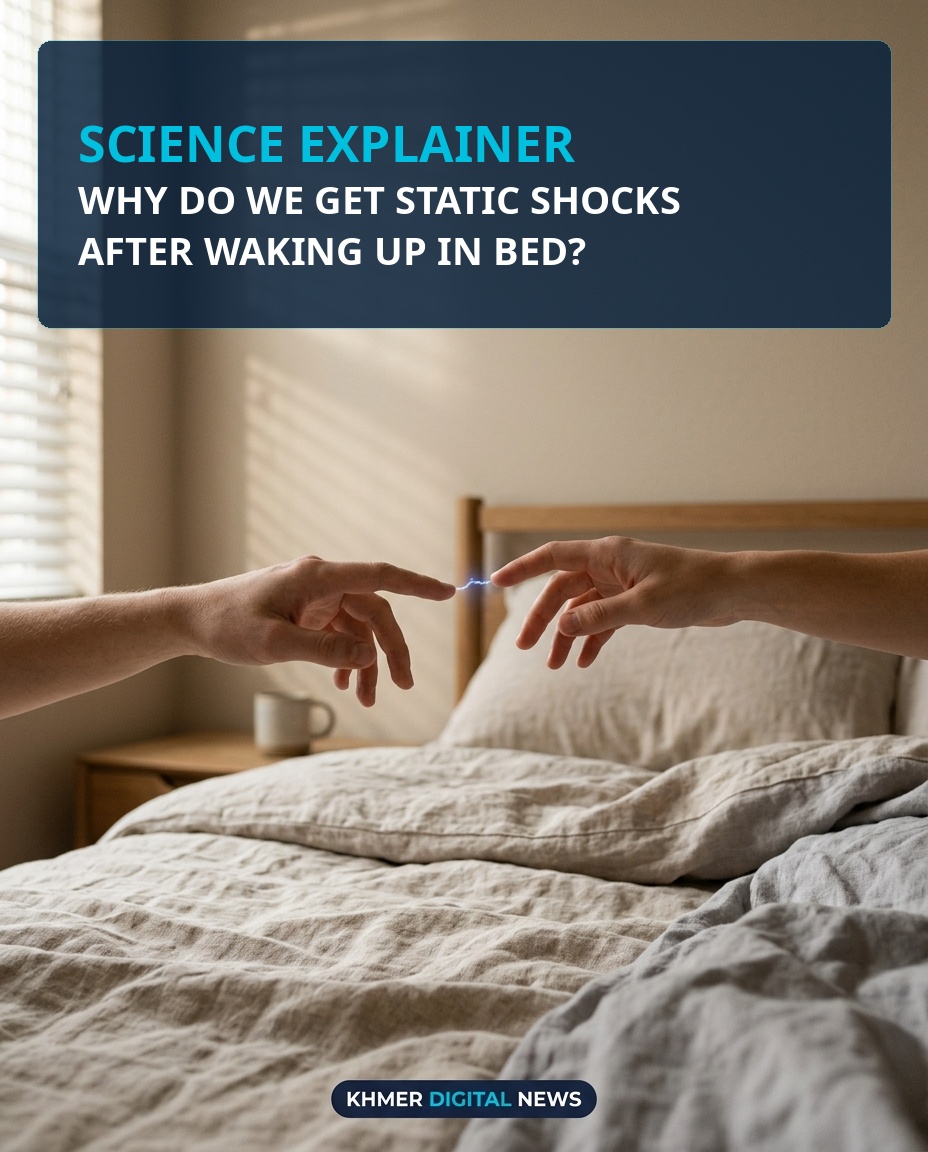
Why Do We Get Static Electricity Shocks When Touching Skin After Waking Up? The Science and Prevention
By Khmer Digital News Editorial Team | Published: October 16, 2026
Key Takeaways:
The sudden zap experienced when touching another person's skin upon waking up is an Electrostatic Discharge (ESD) caused by static electricity buildup.
Overnight tossing and turning creates microscopic friction between skin, sleepwear, and synthetic bedding, transferring electrons via the triboelectric effect.
Dehumidified air produced by air conditioning units prevents accumulated electrical charges from dissipating naturally into moisture, leading to a sudden spark upon contact.
PHNOM PENH — Many people around the world have experienced this startling sensation: you wake up in an air-conditioned bedroom, reach out to touch a loved one's hand or arm, and instantly feel a sharp prickle, occasionally accompanied by an audible snap or a tiny blue spark. While the sensation can be surprising, it is a well-documented physical phenomenon known as static electricity, according to scientific reference authorities including the Library of Congress Science Division and Encyclopedia Britannica.
1. The Triboelectric Effect: How Sleep Generates Static Charges
All physical matter, including the human body, consists of atoms made up of positively charged protons and negatively charged electrons. Under normal equilibrium, these charges remain balanced. However, during seven to eight hours of sleep, individuals naturally shift positions dozens of times. As sleepwear, cotton sheets, and synthetic blankets (such as polyester, microfiber, or fleece) rub against one another and against human skin, electrons detach and transfer from one material to another. Known in physics as the triboelectric effect, this mechanical friction leaves one surface with an excess of negative electrons while the other retains a net positive charge (Library of Congress Everyday Mysteries).
2. Why Air Conditioning Magnifies the Phenomenon
The primary reason static shocks occur predominantly in air-conditioned bedrooms or during dry, cool weather relates directly to ambient humidity. Water vapor in humid air serves as a natural electrical conductor, allowing minor static charges accumulated on human skin to bleed off continuously into the atmosphere throughout the night. By contrast, modern air conditioning systems cool indoor spaces by extracting airborne moisture, frequently dropping relative indoor humidity below 40%. In dry air, the surrounding atmosphere behaves as an electrical insulator. Trapped charges accumulate across the human body until physical contact is made with an object—or another person—of differing electrical potential, prompting thousands of accumulated electrons to bridge the gap instantaneously in an electrostatic discharge (Britannica Science).
3. Is Static Shock Harmful to Human Health?
Despite the abrupt prickling sensation, electrostatic discharges pose zero danger to the human cardiovascular or nervous system. While the electrical potential difference can easily reach 2,000 to over 5,000 volts—sufficient to ionize air and create visible micro-sparks—the actual electrical current (amperage) is negligible, measured in microamperes over a duration of less than a millionth of a second. As a result, the energy delivered cannot cause physical tissue harm or cardiac rhythm disruption.
4. Simple Steps to Prevent Morning Static Shocks
Homeowners and readers seeking to eliminate morning static shocks can implement several practical adjustments:
Restore Bedroom Humidity: Operate an ultrasonic cool-mist humidifier in air-conditioned rooms, maintaining relative humidity between 45% and 50% to facilitate natural charge dissipation.
Hydrate Skin Before Sleep: Applying moisturizing lotion to hands and arms creates a lipid barrier that retains skin moisture and inhibits electron accumulation.
Choose Natural Fiber Bedding: Opt for 100% natural cotton or linen sheets and sleepwear, as natural cellulose fibers are far less prone to triboelectric charging than synthetic polyester or fleece.
Discharge Ground Before Touch: Lightly tap a painted wall, wooden headboard, or the floor with the flat of your hand upon waking to dissipate excess charges gently before touching another person.
Primary Sources: Reported by the Khmer Digital News Editorial Team based on physics research published by the Library of Congress and Encyclopedia Britannica.