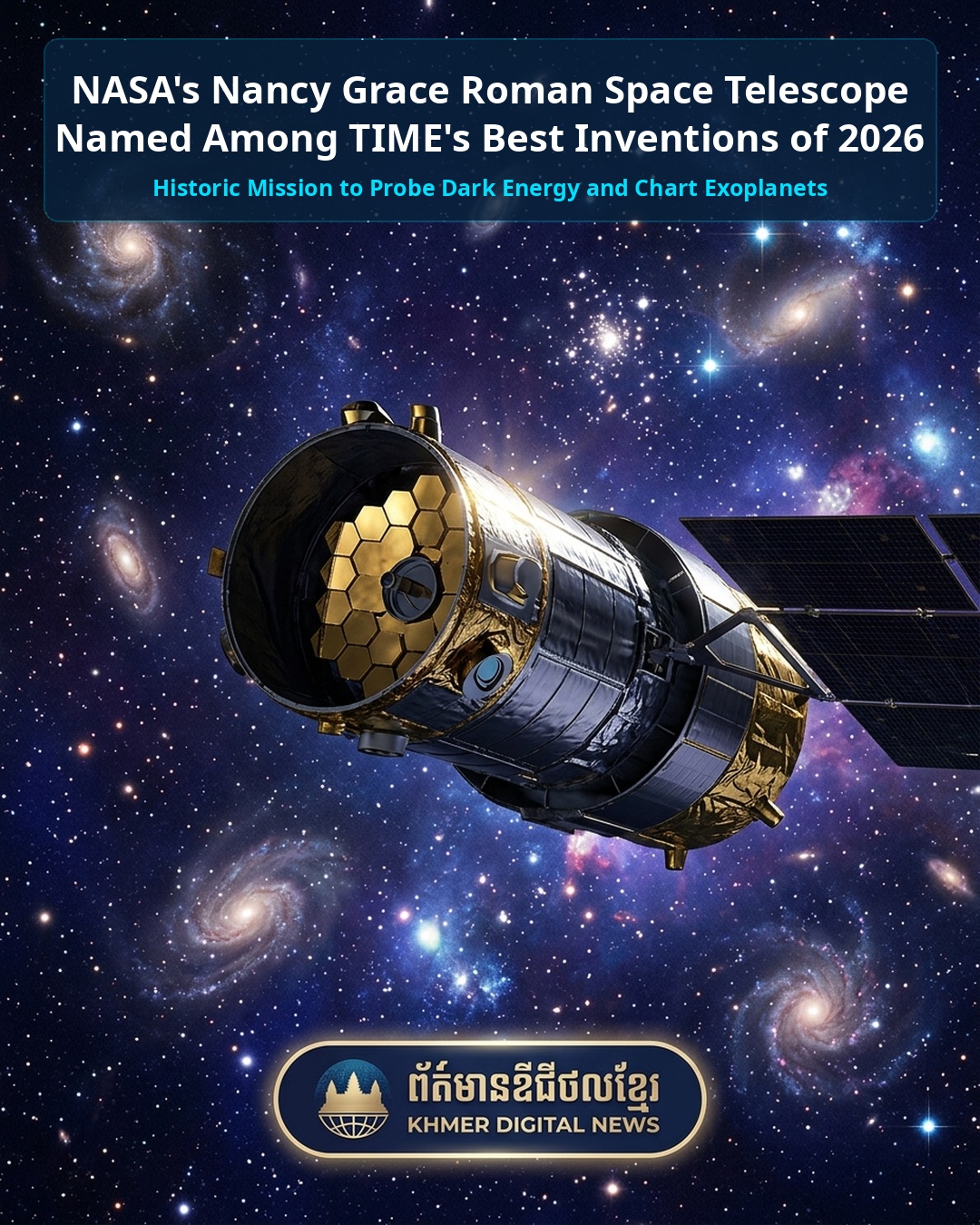
NASA's Nancy Grace Roman Space Telescope Named Among TIME's Best Inventions of 2026
NASA's Nancy Grace Roman Space Telescope has been honored in TIME's Best Inventions of 2026 for its revolutionary wide-field infrared cosmic survey capabilities.
By Khmer Digital News Editorial Team | Published: October 17, 2026
Key Takeaways:
- Prestigious Global Recognition: TIME magazine selected NASA's Nancy Grace Roman Space Telescope for its annual "Best Inventions of 2026" list, celebrating transformative scientific breakthroughs.
- 100x Wider Field of View: The flagship observatory pairs high-resolution infrared imaging with a field of view 100 times greater than the Hubble Space Telescope.
- Unlocking Cosmic Enigmas: Roman will conduct massive cosmic surveys to measure dark energy, map dark matter distributions, and discover thousands of new exoplanets.
Humanity's quest to decode the fundamental nature of the cosmos has achieved another landmark milestone. TIME magazine has officially unveiled its annual list of the "Best Inventions of 2026," honoring NASA's Nancy Grace Roman Space Telescope among the most groundbreaking technological innovations shaping our world.
The prestigious distinction highlights the observatory's revolutionary optical architecture, which combines crisp infrared clarity with a panoramic perspective designed to map billions of galaxies and probe the invisible forces governing cosmic expansion.
1. Unprecedented Wide-Field Cosmic Mapping
Equipped with a 2.4-meter primary mirror and a state-of-the-art 300-megapixel Wide Field Instrument (WFI), the Roman Space Telescope provides an observation window 100 times larger than that of Hubble at comparable resolution. This remarkable optical capability enables Roman to survey vast swaths of the sky in a fraction of the time required by previous space missions.
While the James Webb Space Telescope functions as an ultra-deep cosmic microscope examining individual early galaxies, Roman operates as a wide-angle cosmic surveyor, generating unprecedented statistical datasets across cosmic history.
2. Probing Dark Energy and Exoplanetary Systems
Roughly 95% of the universe consists of dark energy and dark matter—mysterious components that remain undetectable through direct light. Roman's surveys will track how dark energy has influenced the expansion rate of the universe over billions of years by observing hundreds of millions of galaxies and thousands of distant supernovae.
Furthermore, Roman will test an advanced Coronagraph Instrument capable of blocking blinding starlight to image planets orbiting distant stars. This high-contrast technology represents an essential stepping stone toward detecting potentially habitable exoplanets and analyzing their atmospheric signatures.
3. The Lasting Legacy of Dr. Nancy Grace Roman
The mission honors the pioneering astronomer Dr. Nancy Grace Roman, widely recognized as the "Mother of Hubble" and NASA's first Chief of Astronomy. Her tireless advocacy laid the technological and institutional groundwork for space-based observatories that transformed human understanding of the universe.
All data collected by the Roman Space Telescope will be made publicly available immediately without proprietary hold periods, democratizing astronomical discovery for scientists and researchers worldwide.
Frequently Asked Questions (FAQ):
Q: How does the Roman Space Telescope complement the James Webb Space Telescope?
A: While Webb specializes in highly targeted, deep observations of individual cosmic objects, Roman rapidly maps enormous regions of the sky, discovering rare celestial phenomena that Webb can subsequently inspect in detail.
Q: When is the Nancy Grace Roman Space Telescope scheduled to launch?
A: NASA plans to launch the observatory in May 2027 aboard a SpaceX Falcon Heavy rocket from Kennedy Space Center in Florida.
Official Sources: Honors briefing from NASA Science (TIME Best Inventions of 2026) and technical documentation from NASA Technology.