Radiation-Resistant Fungi Could Enable Farming and Bio-Habitats on Mars | Khmer Digital News
Astrobiologists discover that radiation-eating extremophilic fungi can neutralize toxic Martian soil and create lightweight bio-composite building materials.
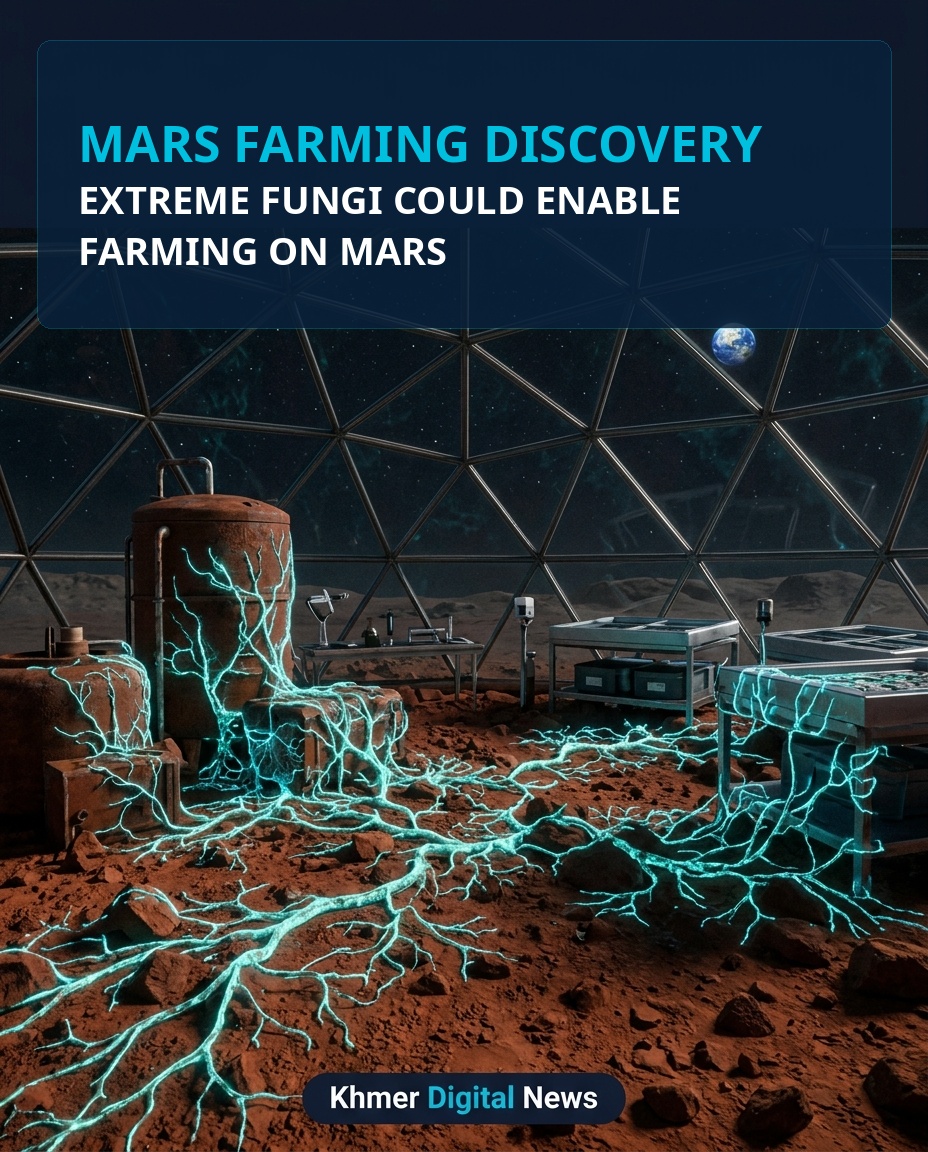
Groundbreaking Discovery: Resilient Fungi Could Enable Agriculture and Habitat Construction on Mars
By Khmer Digital News Editorial Team | Published: October 16, 2026
Key Takeaways:
Astrobiology researchers have demonstrated that specialized extremophilic fungi can survive and metabolize cosmic radiation in simulated Martian conditions.
Fungal mycelium networks effectively break down toxic perchlorates found in Martian regolith, turning sterile dust into viable agricultural soil.
Through myco-architecture, fungal roots can bind Martian dust into durable, radiation-shielding bio-composites for astronaut habitats.
LONDON — In a landmark astrobiological study, international researchers have unveiled evidence indicating that specialized fungal organisms—specifically melanized extremophilic fungi—could provide the biological foundation needed to overcome humanity's greatest hurdles on Mars: sustainable agricultural food production and radiation-shielded habitat construction, according to findings published by Discover Wildlife.
Overcoming the Harsh Reality of Martian Regolith
Unlike fertile terrestrial soil teeming with microbial life, Martian regolith presents severe challenges to plant cultivation. It is laced with hazardous perchlorate salts, devoid of organic matter, and subject to intense cosmic and ultraviolet radiation due to the planet's thin atmosphere. However, astrobiologists examining fungi isolated from extreme environments on Earth—including high-radiation zones around Chernobyl—found that melanin-rich fungi utilize radiosynthesis, converting ionizing radiation into chemical energy. In laboratory simulations replicating Martian atmospheric pressure and gas composition, the fungal strains demonstrated an ability to neutralize perchlorates while enriching the sterile substrate with organic carbon and bio-available nitrogen (Discover Wildlife Astrobiology).
Myco-Architecture: Growing Structures from Living Organisms
Beyond soil remediation, the architectural utility of fungal vegetative bodies, known as mycelium, has garnered substantial interest from space agencies. When introduced into crushed Martian rock simulant, mycelial threads weave an interconnected fibrous matrix, hardening into a lightweight bio-composite material with compressive strength comparable to conventional brickwork. Remarkably, these mycelial composites provide superior radiation attenuation compared to steel or concrete, absorbing harmful solar particle events while eliminating the prohibitive financial cost of launching heavy building supplies from Earth.
Implications for the Future of Human Exploration
As NASA, the European Space Agency (ESA), and private space ventures design closed-loop life support architectures for human Mars expeditions in the late 2030s, biological self-sufficiency has become paramount. Scientists emphasize that harnessing the evolutionary adaptability of fungi offers an elegant, low-mass solution that bridges biology and structural engineering, transforming the Red Planet from a hostile desert into a sustainable outpost for human civilization.
Primary Sources: Reported by the Khmer Digital News Editorial Team based on astrobiology research from Discover Wildlife.