
Why Do We Get Goosebumps When We're Cold or Frightened? The Ancient Science of Piloerection
Discover the evolutionary science behind goosebumps (piloerection), why our hair stands on end when chilly or frightened, and emotional frisson.
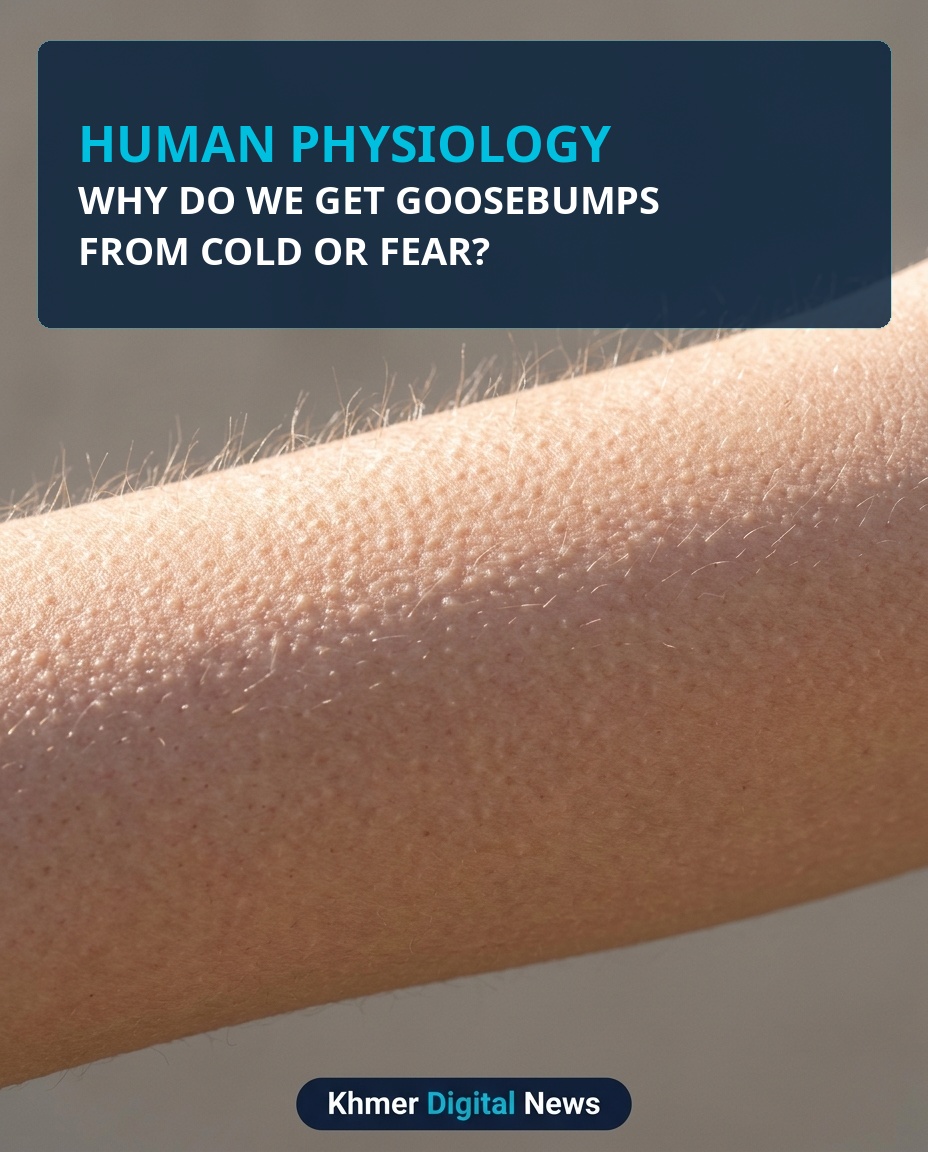
By Khmer Digital News Editorial Team | Published: October 16, 2026
Key Takeaways:
- Goosebumps, scientifically known as piloerection, occur when tiny arrector pili muscles contract at the base of every hair follicle.
- In cold conditions, upright hairs trap a layer of insulating air; during acute fear, adrenaline-driven piloerection made our hairy ancestors appear larger to predators.
- Emotional goosebumps (frisson) triggered by moving music or art stem from dopamine surges stimulating autonomic emotional pathways.
PHNOM PENH — A sharp winter breeze brushes your skin, or an awe-inspiring vocal crescendo swells in your headphones, and instantaneously, tiny dimpled bumps erupt across your arms while fine hairs stand upright. Colloquially termed "goosebumps" (or goose pimples), this universal physiological reflex is known in medicine as piloerection, an evolutionary relic illuminated in research by Scientific American.
1. Cellular Anatomy: The Arrector Pili Mechanism
Every single hair follicle embedded within human dermal tissue is anchored by a microscopic band of smooth muscle fiber termed the arrector pili. When the sympathetic nervous system senses external cold or psychological shock, it discharges neural impulses along adrenergic nerve fibers. These signals cause the arrector pili to contract forcefully. Because the muscle connects obliquely to the hair bulb, contraction forces the hair shaft into an upright posture while simultaneously depressing the surrounding skin, yielding characteristic surface nodules reminiscent of a plucked bird (Scientific American Evolutionary Physiology).
2. Dual Evolutionary Survival Functions: Insulation and Intimidation
In modern humans with sparse body hair, goosebumps serve little practical thermal purpose. However, in heavily furred mammalian ancestors, the reflex served two vital survival functions:
- Thermal Insulation: Raising fur shafts increases the thickness of the trapped air boundary layer directly adjacent to the skin, drastically reducing convective heat loss in freezing climates.
- Predator Deterrence: Under perceived mortal danger, the sympathetic "fight-or-flight" surge floods the bloodstream with adrenaline. Piloerection caused early hominids and animals to visibly swell in apparent body volume—a dynamic observable today when a threatened cat arches its back and puffs its coat.
3. The Wonder of Musical 'Frisson'
Remarkably, humans frequently experience piloerection without physical chill or fear. Experiencing extraordinary acoustic harmony, profound speeches, or intense cinematic moments can induce aesthetic chills, known scientifically as frisson. Neuroimaging reveals that peak aesthetic experiences stimulate sudden surges of dopamine within the striatum, briefly activating the same ancient autonomic pathways that once guarded our ancestors in the wild.
Primary Sources: Reported by the Khmer Digital News Editorial Team based on evolutionary biology research from Scientific American.