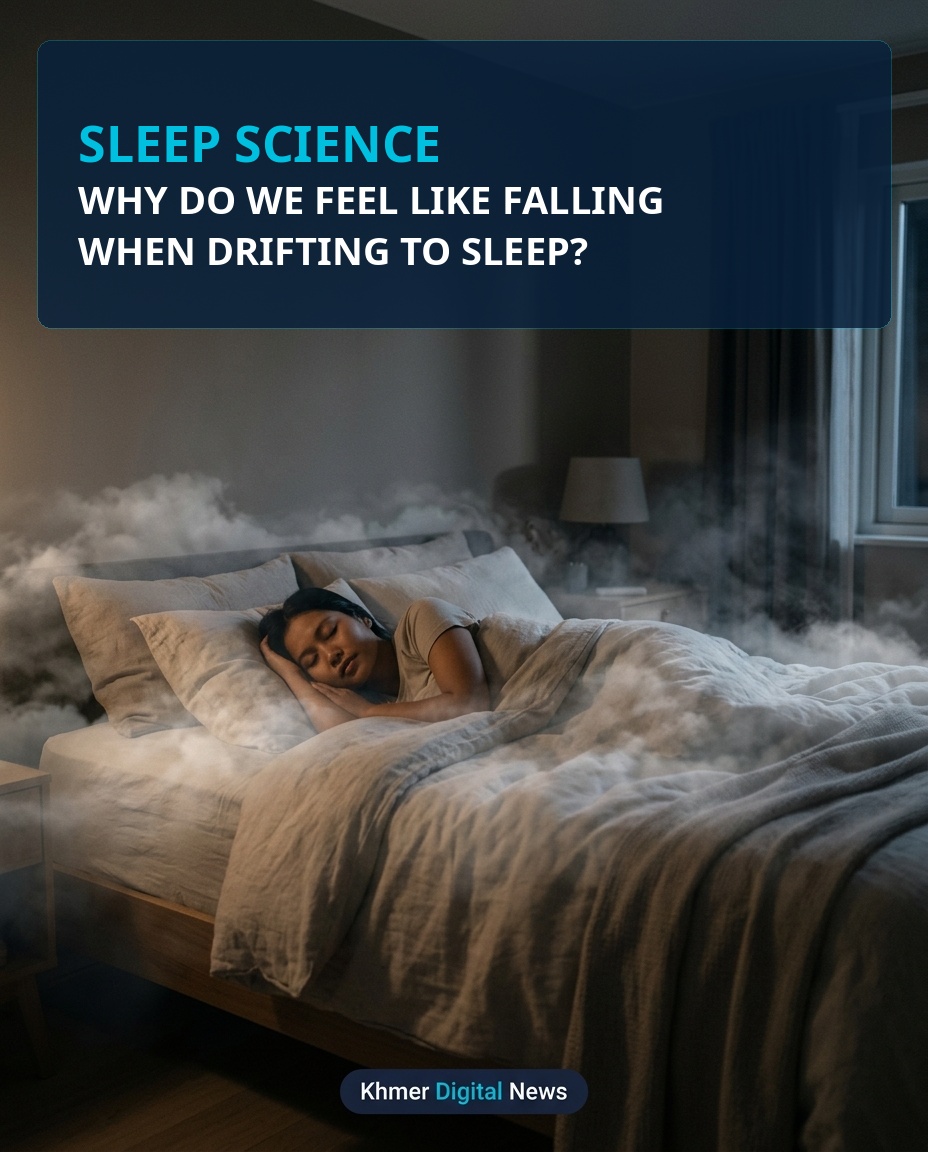
Why Do You Twitch or Feel Like You're Falling When Drifting Off to Sleep? The Science of Hypnic Jerks
Discover the neurological science behind hypnic jerks, why your body suddenly twitches or feels like falling when falling asleep, and how to minimize it.
By Khmer Digital News Editorial Team | Published: October 16, 2026
Key Takeaways:
- The startling sensation of suddenly falling or violently twitching awake right as you drift off to sleep is medically classified as a hypnic jerk (or sleep start).
- It results from an abrupt transition between the brain's arousal system and sleep centers, where sudden muscle relaxation is momentarily misinterpreted as a physical fall.
- Hypnic jerks are completely harmless and affect over 70% of the global population, though sleep deprivation, chronic stress, and late caffeine intake amplify their frequency.
PHNOM PENH — It is a nearly universal human experience: you lay in bed after an exhausting day, close your eyes, and begin drifting peacefully toward sleep. Suddenly, an intense sensation sweeps over your body—as if the ground has dropped out beneath you or you have stepped off a high ledge. Your legs violently kick, your arms flail, and you jolt completely awake with a racing heartbeat. Known scientifically as a hypnic jerk, this startling phenomenon is a normal physiological occurrence documented extensively by researchers at the Sleep Foundation.
1. Neurological Origins: The Brain's Shifting Control Centers
Sleep is not an instantaneous switch; rather, it represents a delicate biological tug-of-war between two opposing neurological networks. The reticular activating system (RAS), which maintains conscious vigilance, gradually yields control to the ventrolateral preoptic nucleus, which orchestrates sleep. As brain waves slow from active beta to relaxed theta patterns, our motor cortex sends inhibitory signals down the spinal cord, inducing profound muscle flaccidity. In some instances, however, this motor relaxation occurs unevenly or too rapidly. The evolutionary threat-detection circuitry in the brain misinterprets the rapid drop in muscle tone as a sign that the body is tumbling from a tree or high cliff—a vestigial reflex inherited from arboreal ancestors. To prevent injury, the motor cortex fires an instantaneous neural discharge, causing a sudden involuntary muscle spasm (Sleep Foundation Parasomnias Research).
2. Key Triggers: Why Some Nights Are More Restless
While hypnic jerks occur benignly across all demographics, neurological studies demonstrate that specific physiological stressors significantly increase their intensity and recurrence:
- Acute Exhaustion and Irregular Sleep: When severely overtired, the brain skips transitional sleep stages, accelerating neural miscommunication between consciousness and motor relaxation.
- Elevated Cortisol and Psychological Stress: High stress keeps sympathetic nervous activity active, making motor neurons prone to spontaneous excitation.
- Evening Stimulants: Consuming coffee, energy drinks, or nicotine within six hours of bedtime disrupts the smooth transition into deep sleep.
3. Clinical Perspective and Prevention
Sleep neurologists affirm that isolated hypnic jerks carry no clinical risks. Simple lifestyle adjustments—such as keeping a consistent sleep schedule, engaging in pre-bedtime breathwork, and reducing evening caffeine—reliably smooth the neurological bridge between waking life and tranquil sleep.
Primary Sources: Reported by the Khmer Digital News Editorial Team based on sleep neuroscience research from the Sleep Foundation.