
Why Do Fingers and Toes Wrinkle in Water? The Brilliant Evolutionary Secret Behind 'Pruney' Skin
Discover why water makes your fingers prune. It's not osmosis, but an active nervous system reflex designed by evolution to enhance wet grip.
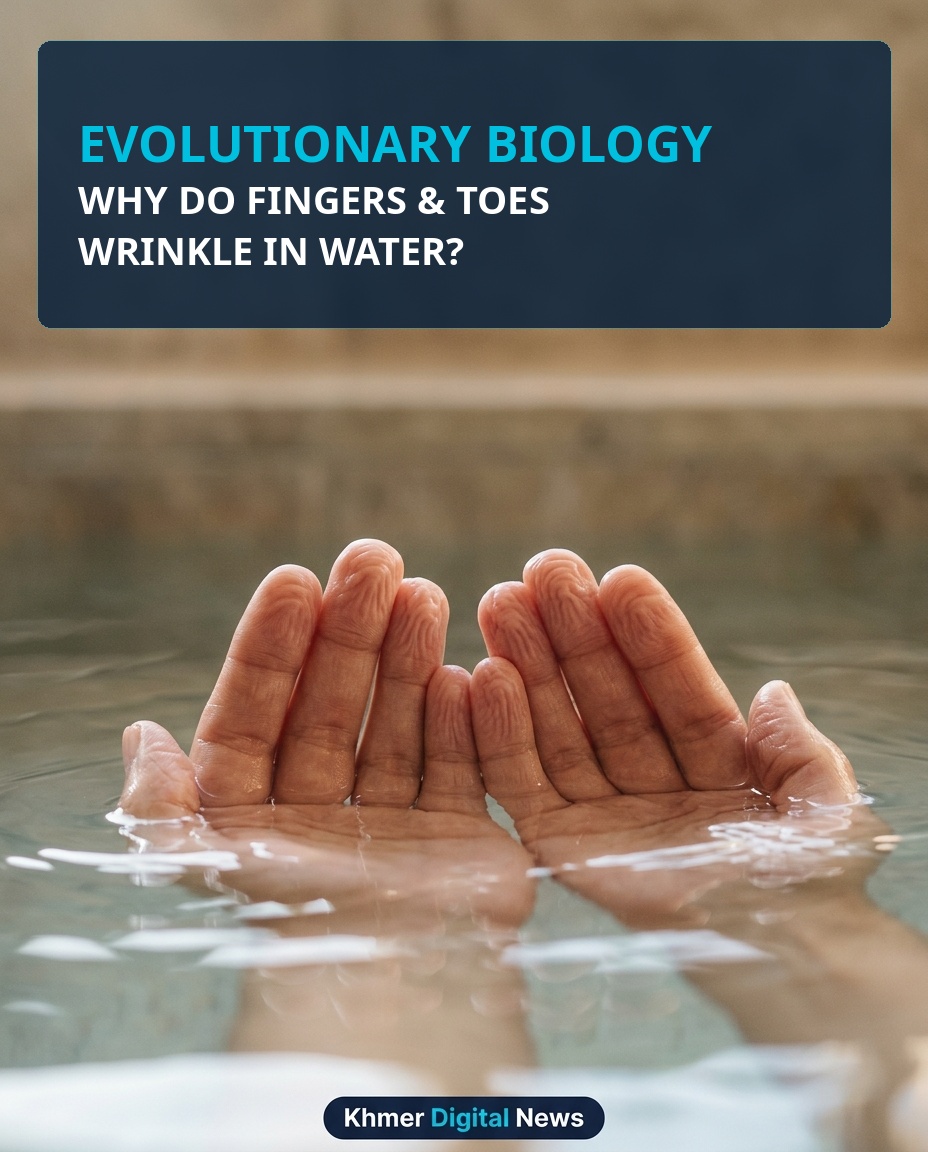
By Khmer Digital News Editorial Team | Published: October 16, 2026
Key Takeaways:
- Wrinkling of the hands and feet in water is not a passive osmotic swelling process, but an active reflex controlled by the sympathetic nervous system.
- Water immersion prompts localized vasoconstriction, pulling the deep layers of the skin downward to create organized drainage ridges.
- These morphological channels act like tire rain treads, channeling fluid away to boost wet grip traction by up to 12% on submerged objects.
PHNOM PENH — Whether spending twenty minutes in a warm bath, swimming in a pool, or washing dishes, the outcome is invariably identical: the fleshy pads of your fingers and soles of your feet transform into a maze of deep, puckered ridges. For generations, school textbooks taught that the outer stratum corneum simply swelled like a sponge through osmotic water absorption. However, modern neurobiology and evolutionary anthropology have comprehensively dismantled this myth, revealing a sophisticated physiological mechanism documented by the Library of Congress Science Division.
1. Debunking the Sponge Myth: The Neurological Proof
The definitive proof that water wrinkling is not passive absorption came from clinical neurology. Decades ago, surgeons noted that patients who had suffered severed median or digital nerves completely lost the ability to develop wrinkled fingertips on affected digits, despite hours of water immersion. Because denervated fingers remain completely smooth in water, scientists realized that wrinkling requires an intact, functioning nervous system sending direct operational commands to local tissues.
2. Autonomic Vasoconstriction: How Ridges Are Formed
When the glomus bodies—specialized thermo-receptive vascular structures in the skin—detect prolonged moisture, they fire signals through the sympathetic nervous system. In response, smooth muscles encircling subcutaneous digital arterioles contract vigorously, a process known as vasoconstriction. As blood volume drains out of the deep dermal layers, the underlying tissue volume shrinks significantly. Because the rigid outer epidermal layers do not decrease in surface area, they are pulled downward into the newly created negative space, folding into deliberate, topographical ridges (Library of Congress Biological Mysteries).
3. The Evolutionary Purpose: Nature's Tire Treads
Why would natural selection preserve such an energy-intensive reflex? Landmark biomechanical studies conducted in recent years have demonstrated that wrinkled fingertips function precisely like the drainage sipes on automotive rain tires. When an individual attempts to grasp a slippery, submerged object, the valleys between the wrinkles channel water away from the contact points, allowing skin pads to achieve direct friction. Evolutionary biologists hypothesize that this adaptation provided early hominids with a decisive survival advantage—enabling our ancestors to gather wet riverbed mollusks, handle tools in monsoonal downpours, and maintain footing across mossy, slick boulders.
Primary Sources: Reported by the Khmer Digital News Editorial Team based on evolutionary biology research from the Library of Congress.